Microphones for Large Meeting Rooms: Which Type to Choose, How Many to Place, and How to Deal with Room Reflections
There are several ways to pick up sound in a large meeting room, each with trade-offs. This guide compares one microphone per person, tabletop omnidirectional units and ceiling arrays, explains the limits of omnidirectional pickup such as the SM-500 and SM-800, and shows how to improve the echo caused by glass walls and hard floors.
Short answer
There are a few common ways to pick up sound in a large meeting room. A microphone for each person (handheld or gooseneck) is the clearest, but needs the most equipment and cabling. Omnidirectional speakerphones on the table (SM-500, SM-800) are the easiest to install, but they also pick up reflected sound and noise. A ceiling array (DMA-702) keeps the table clear, but sits furthest from the talkers. The limit of omnidirectional pickup is that it cannot tell a voice from the sound bouncing back, and the more glass and hard floor in the room, the more obvious it becomes. To improve it, work in this order: add units to shorten the distance, add sound absorption, adjust the loudspeakers, choose equipment with full audio processing, and switch to close-up microphones only when conditions are poor. To estimate the number of units: one SM-500 covers a radius of 4 metres, so a table up to 6 metres takes one and a long table of about 12 metres takes three. Always test with sample units in the room.
Key takeaways
- The common approaches are one microphone per person, omnidirectional units on the table, a ceiling array, and boundary microphones with an audio processor; each has trade-offs and none is best at everything
- Omnidirectional units (SM-500, SM-800) are the easiest to install, but they cannot tell a voice from reflected sound; the further the talker and the harder the room, the thinner the voice sounds
- Glass walls, tile floors, hard ceilings and parallel walls make sound bounce around, which sounds muddy and echoey; audio processing can reduce it, but it cannot change the room
- To improve it: add units to shorten the distance, add sound absorption, adjust the loudspeakers, choose equipment with full audio processing, and use close-up microphones only when conditions are poor
- SM-500: radius 4 m, up to 4 units; SM-800: radius 3 m, up to 6 chained; DMA-702: radius 3 m, up to 6 chained
- Unit counts and results both depend on the room, so always test with sample units in the room first
In a small meeting room, one speakerphone in the middle of the table lets everyone hear. As the room grows, the table gets longer or turns into a U shape, and the people at the other end cannot be heard, and cannot hear the other side. A louder microphone does not help. Two things matter: how far people are from the microphone, and how sound bounces around in the room.
A large room can pick up sound in several ways: a microphone for each person, omnidirectional speakerphones on the table, or an array microphone on the ceiling. Each one gains something and gives something up.
There are several guides on video conference rooms, each for one job. Start with “What to buy for a video conference room” for the whole picture, then read on as needed:
| Guide | What you will learn |
|---|---|
| What to buy for a video conference room (start here) › | Cameras, audio, connections, and the table of setups by room size |
| How to choose a meeting room camera › | Camera by room size and headcount, PTZ, auto tracking, mounting |
| How to choose a conference speakerphone › | Fixing sound that is unclear, echo and noise, and choosing an audio setup |
| Huddle room setup › | Small rooms for 2 to 6 people: three setups and how to expand |
| Microphones for large meeting rooms (you are reading this one) | Pickup options and how many for a big space, and how to deal with room reflections |
| How to choose a USB extension › | What to check when a short cable works but a long one fails |
| Why medium and large rooms use PTZ › | 5 reasons to use a PTZ camera (for what PTZ is, see “What is a PTZ camera”) |
Why is one microphone not enough in a large room?
One microphone covers one circle: people inside it are picked up, people outside it are hard to hear. When the room is bigger, with a longer table and spread-out seats, people outside the circle have to lean in to be heard, and they cannot hear the other side either.
So the answer for a large room is “use several, with the circles overlapping”: each unit looks after one area, neighbouring circles overlap a little, and the whole table has no dead spot. Each unit is a speakerphone with a loudspeaker, so every seat also hears the other side.
The common ways to pick up sound in a large room, and their trade-offs
There is one basic rule: the closer the mouth is to the microphone, the clearer the voice and the less other sound gets in. Every approach trades between how close the microphone is to the talker, how simple the equipment is, and how clear the table stays.
| Approach | What you gain | What you give up | Suits |
|---|---|---|---|
| One per person (handheld, gooseneck, lapel) | The microphone is closest to the mouth, so the voice is clearest and picks up the least from around it | One for every seat, with cables or charging; echo has to be handled by a separate audio processor and loudspeakers; a handheld needs someone to hold it | Formal meetings where everyone has to be picked up clearly |
| Omnidirectional speakerphones on the table (SM-500, SM-800) | Microphone, loudspeaker and audio processing in one unit, and it works once it is plugged into the computer; several units cover a long or U-shaped table; no construction | Omnidirectional pickup takes in reflected sound and noise too, more so the further the talker; units sit on the table | Ordinary long or U-shaped tables that need quick installation and may be extended later |
| Professional ceiling array microphone systems (Shure MXA920, Sennheiser TeamConnect Ceiling 2, Audio-Technica ATND1061, Yamaha RM-CG and others) | A clear table; pickup areas that can be automatic or set by hand, focusing on the person speaking; one network cable carries sound and power; can be integrated deeply with audio processors, cameras and room control systems | The microphone is further from the talkers, so rooms with a high ceiling or many reflections need extra testing; it needs ceiling work and network cabling, and is usually designed and tuned by a professional integrator | Mid-size and large rooms with a professional integrator, integrated with a full audio and control system |
| AI ceiling meeting microphone (DMA-702) | A clear table with no cables; several units chained with network cable; AI enhances the person who is speaking; can be paired with the DMA-702P to bring in existing microphones | Also further from the talkers, with ceiling work and network cabling; rooms with a high ceiling or many reflections need extra testing | Mid-size and large rooms that want quick installation and a clear table |
| Boundary (flat tabletop) microphones | Low-profile, one unit can serve several people, and it can be extended | The loudspeaker has to be connected separately, so the system is more complex | Rooms that already have an audio system |
| Ordinary microphones with an audio processor | You can keep the existing microphones and amplifier, with the most flexibility | Someone has to design and tune it, and poor tuning still leaves echo | Rooms that already have microphones and speakers and only lack echo handling |
One per person: the clearest, and the most work
With a microphone in front of everyone, the voice is naturally the cleanest. The price is equipment: one for every seat, with cables or charging, plus an audio processor and loudspeakers to handle echo. In a large room where people often change seats, it takes more effort to look after.
Omnidirectional units on the table: the easiest to install, but it depends on the room
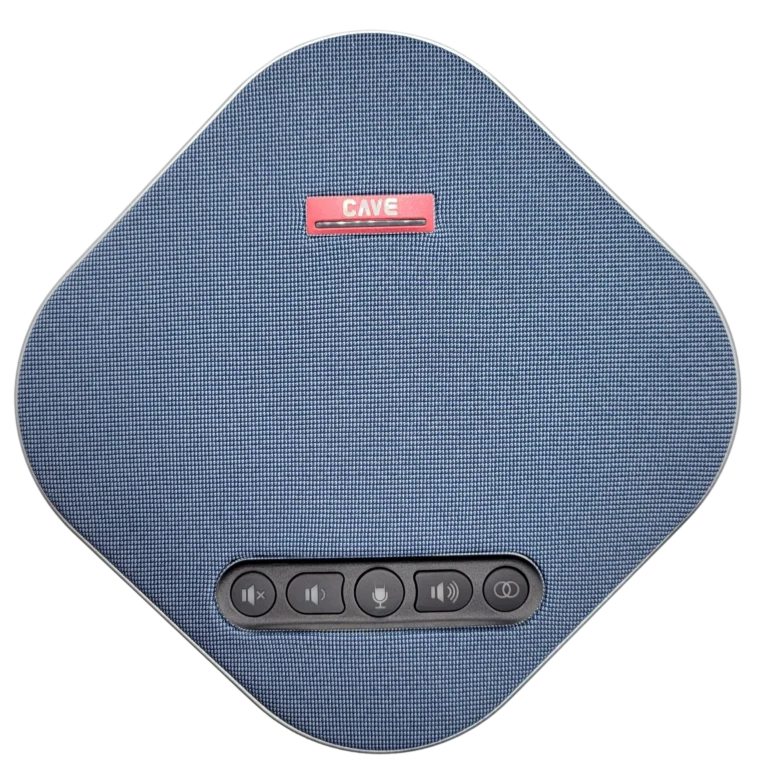
With units like the SM-500 and SM-800, the microphone, loudspeaker and audio processing are all in one unit: put it on the table, plug it into the computer, and the meeting works, with no construction and an easy way to add units. What you gain is simple installation; what you give up is control over the room, because pickup is omnidirectional and the sound conditions of the room show up directly in the result. The limit is explained below.
Ceiling array: the clearest table, and the furthest from the talkers
A ceiling array microphone goes on the ceiling, so nothing needs to sit on the table and there are no cables. What you gain is a clear table; what you give up is distance: the microphone is above people, further from the mouth than a unit on the table, so the ceiling height and the reflections in the room need extra attention when planning. These microphones come in two kinds of positioning:
Professional ceiling array systems: many functions, built by an integrator
This is the usual approach in professional audio integration. The main systems on the market include:
| System | Features |
|---|---|
| Shure MXA920 | Pickup can be automatic coverage or set by hand, with up to 8 pickup lobes that each have their own output; Dante/AES67 network audio, with sound, power and control on one network cable; control commands for integration with third-party cameras and room control systems |
| Sennheiser TeamConnect Ceiling 2 | 28 omnidirectional capsules with automatic adaptive beamforming that focuses on the person speaking; two Dante network ports that can be used for redundancy; powered over PoE, and an analogue output for older audio processors |
| Audio-Technica ATND1061 | A beamforming ceiling microphone in a Dante version and an A-T LINK version; built-in processing including automixing, echo cancellation and noise reduction; exclusion zones can be set in the software to avoid fixed noise sources such as air-conditioning outlets; flush or surface mounting |
| Yamaha RM-CG | The ceiling microphone of the Yamaha ADECIA system, forming up to four beams at once so that several people speaking can be tracked together; Dante audio and PoE power on the same network cable; with the RM-CR remote conference processor (sold separately) it is detected and set up automatically |
This is summarised from the public information of each maker; models and versions differ, so follow the maker documents for specifications and functions. What these systems have in common is full functions and deep integration, and the price is that a professional integrator has to plan, install and tune them.
DMA-702: an AI ceiling microphone for quick installation
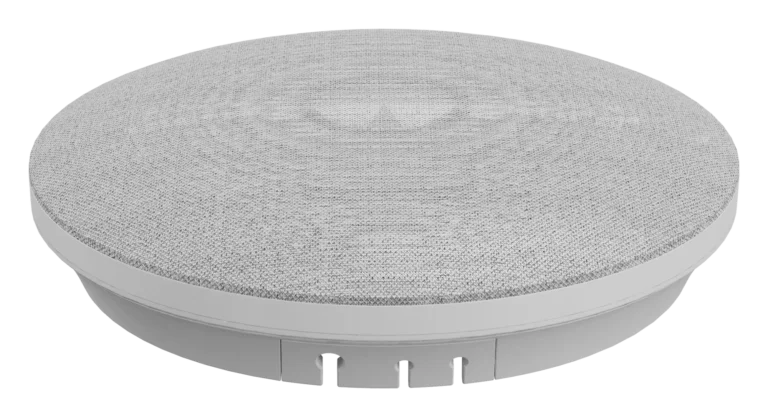
The DMA-702 is positioned differently from the systems above: the point is to let mid-size and large rooms get started quickly. Six omnidirectional microphones form an array with 360° pickup, and AI enhances the voice of the person speaking; several units are chained with network cable, with power, sound and control signals on one cable; with the DMA-702P audio processor, existing handheld microphones can be brought in as well. Which to choose depends on how deeply the room has to be integrated and whether a professional integrator is involved.
Counting the units: by the shape of the table
Long tables: along the centre line
The long table is the most common meeting room. Place the units one after another along the centre line, so every seat is near a microphone and a loudspeaker. With the SM-500, which covers a radius of 4 metres: a table up to 6 metres takes one; a long table of about 12 metres takes three, along the centre line.
U-shaped tables: every side needs one
In a U-shaped table the seats face the middle, and people on one side are further from the other sides, so every side needs a microphone. With the SM-500, a U-shaped table of about 8 by 8 metres takes one on each of three sides; a bigger U-shaped table takes four, one on each side and two on the base. The SM-800 follows the same idea, placed along each side of the U and chained one after another.
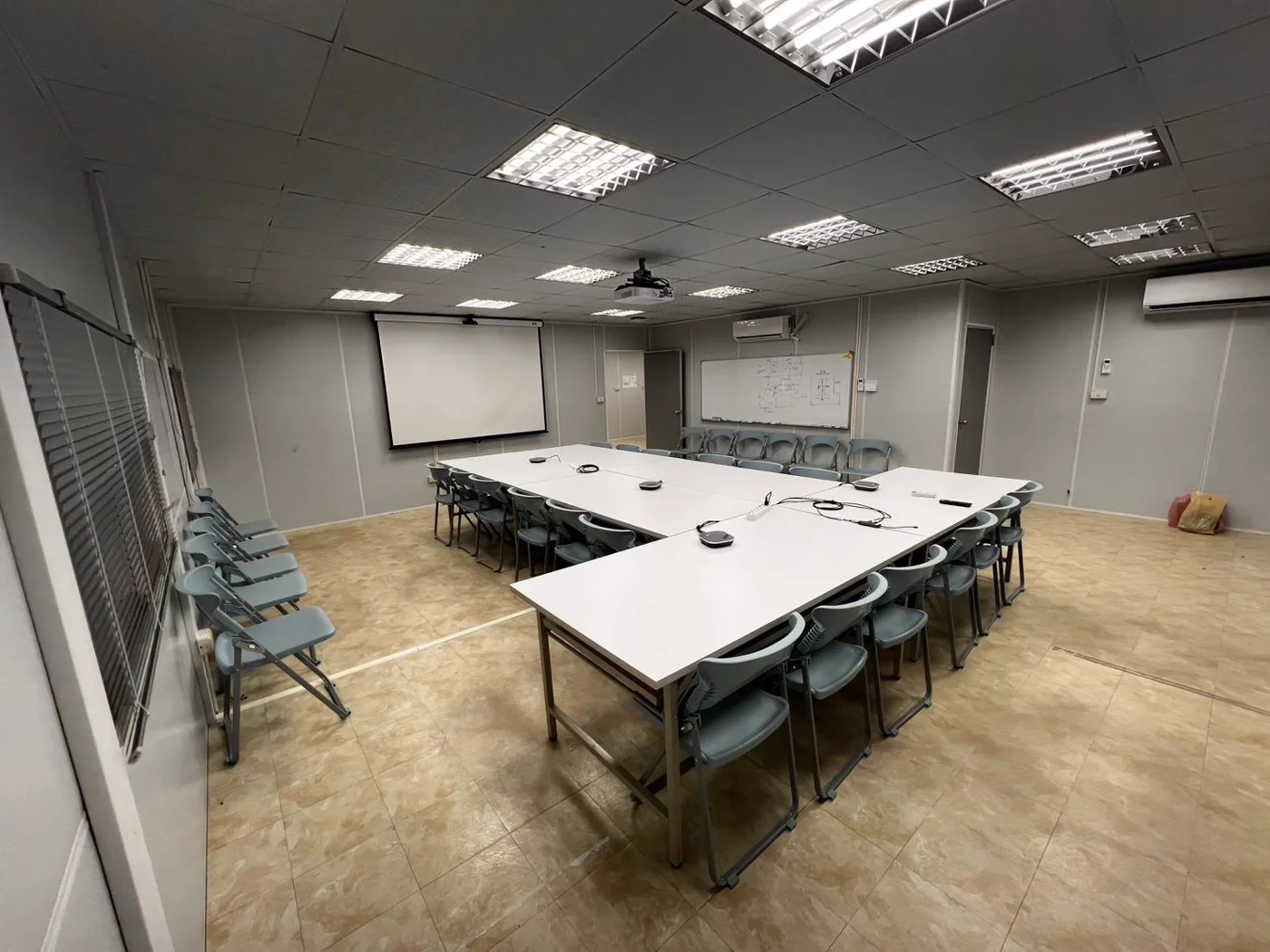
Bigger spaces: chain or combine several units
A bigger space and more tables need more units. The SM-800 can be chained up to six, one after another with the dedicated cable; how many you use depends on the size of the room and what you need, and you can add more later when the room gets bigger or more people attend. The SM-500 can be used up to four together.
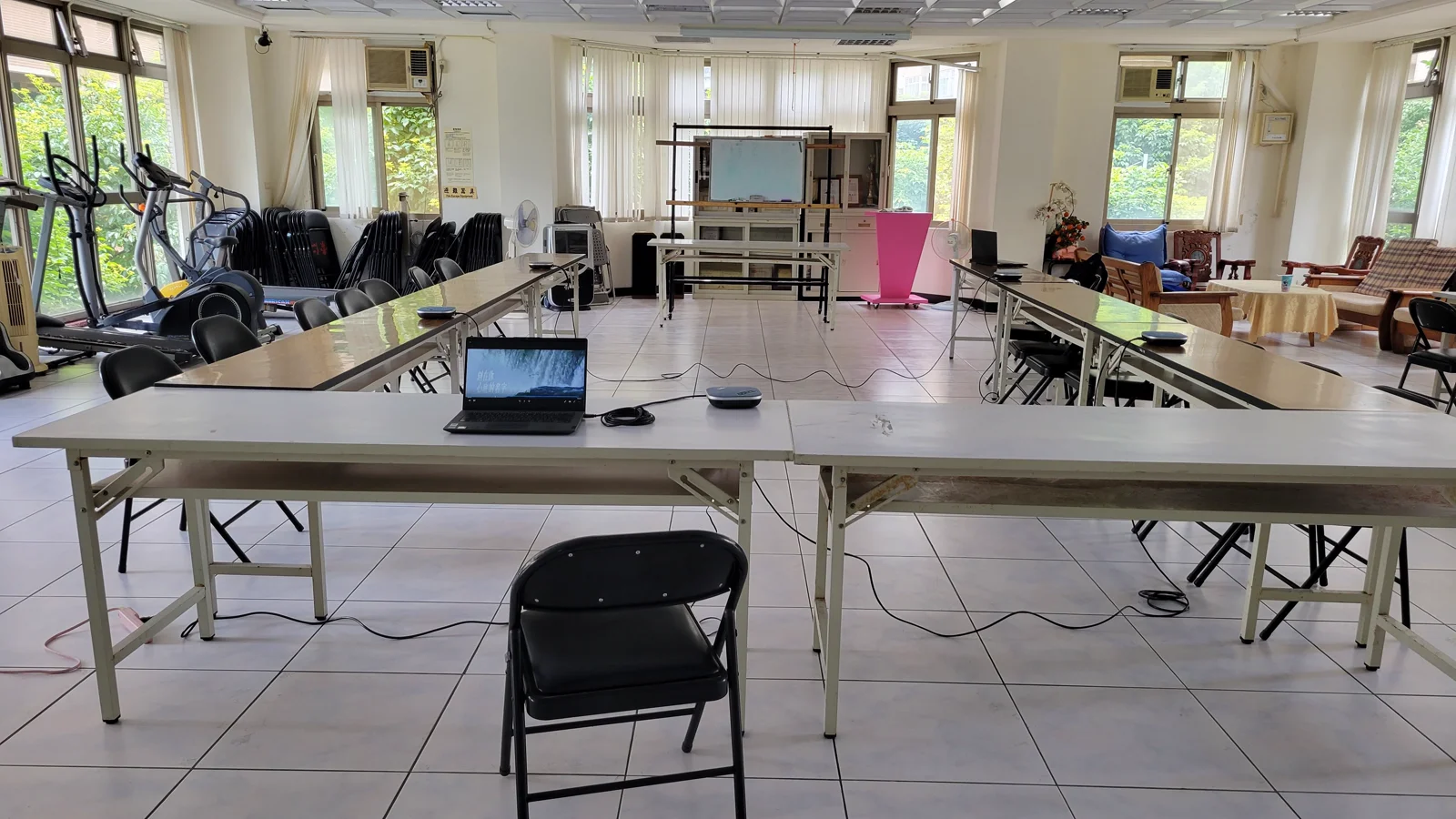
On the ceiling (DMA-702): nothing on the table
The DMA-702 is an array microphone for the ceiling: six omnidirectional microphones in an array, 360° pickup, covering a radius of 3 metres, with AI that enhances the voice of the person who is speaking. A long table of about 6 by 10 metres takes two; a U-shaped table 8 to 10 metres wide and about 10 metres long takes four, and one about 14 metres long takes six. Several units are chained with network cable (PoE+), with power, sound and control signals on the same cable, up to six.
The limits of omnidirectional pickup: the SM-500 and SM-800 as examples
The good thing about an omnidirectional microphone such as the SM-500 or SM-800 is that you do not aim it at anyone: put it in the middle of the table and people in every direction are picked up. The same property is its limit: it takes in sound from every direction and cannot tell which is a voice and which is something else.
- Distance: the further a person is, the weaker the voice, but the air conditioner, the projector fan and the sound reflected off the walls do not get weaker with it, so people far away sound thinner and muddier. The pickup radius in the specifications (4 metres for the SM-500, 3 metres for the SM-800) is a pickup range, and does not mean every position inside it is equally clear.
- Reflections: sound bouncing back from walls, glass and the table is picked up as well, and what is said gets stretched out by its own echo.
- Noise: typing, paper, chairs being moved and knocks on the table, which are close to the microphone, are often louder than a voice further away.
- Several people talking at once: an omnidirectional microphone does not pick one person, so everyone is picked up together and sent to the other side together.
- Processing has a limit: echo cancellation, noise suppression and automatic gain can deal with the sound from the loudspeaker that is picked up again, with steady background sound, and can even out the volume; but sound that has already bounced around the room and mixed with the voice cannot be fully separated. The SM-800 also has built-in reverberation suppression, which reduces reverberation, and the room itself is still the key to the result.
This does not mean omnidirectional microphones work badly. In most rooms in ordinary condition they are the easiest approach. The limit only becomes obvious when the room is very hard, very noisy or very empty.
Room acoustics: why sound gets muddy and echoey
Large meeting rooms run into trouble more easily because of distance: the further a person is from the microphone, the smaller the share of direct sound and the more reflected sound there is, and the muddier it gets. The basics of direct sound, reflected sound and reverberation, and the conditions that increase reflections, are in the section on reverberation in the guide to choosing speakers and microphones.
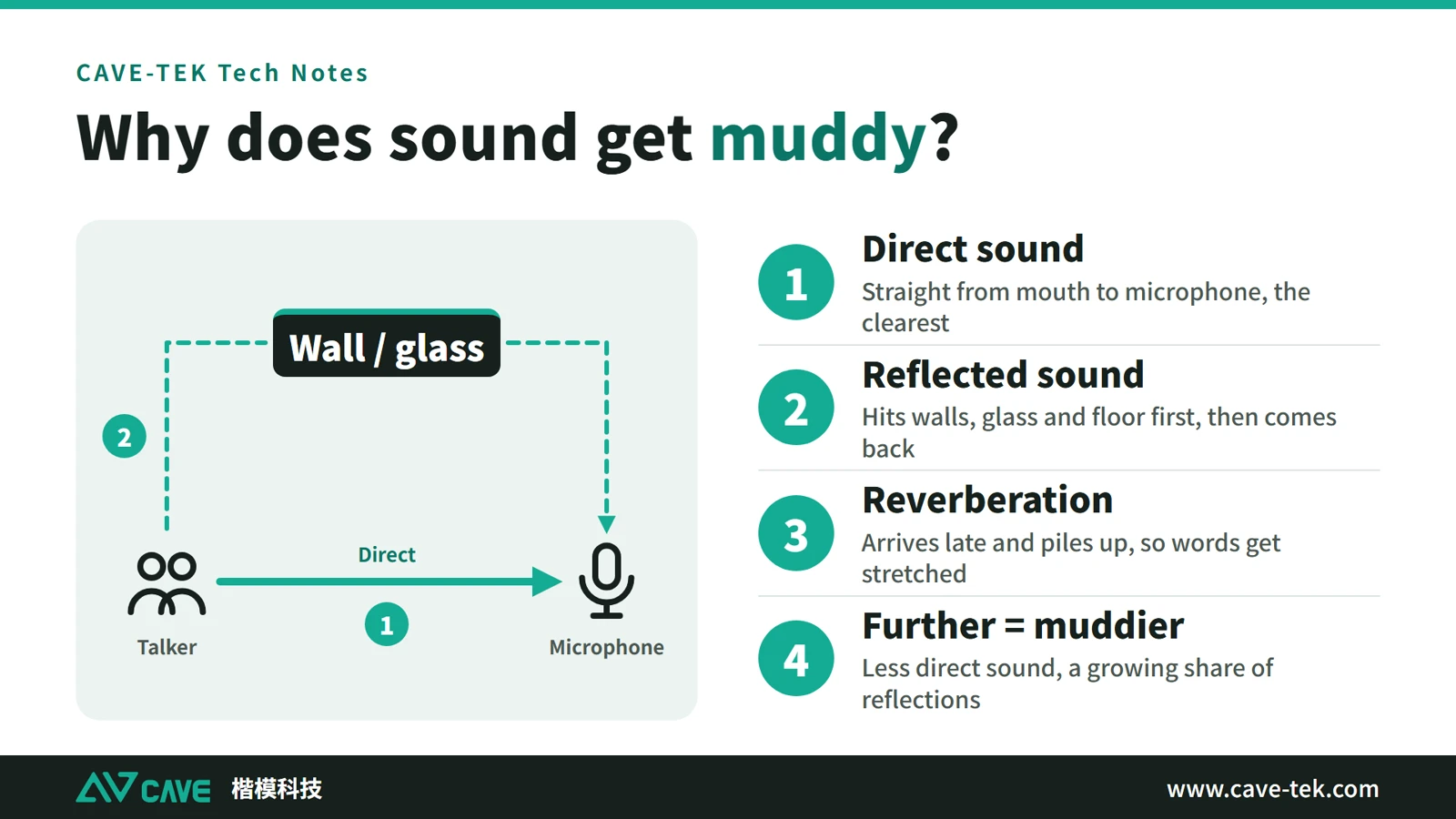
Reflections also make echo harder to handle. When the sound from the loudspeaker bounces around the room for a long time before it dies away, the tail that echo cancellation has to chase gets longer, and it is harder to remove cleanly.
How to improve the room acoustics: start with the simple things
- Bring the microphones closer to people: add units so every seat falls within the range of one. A shorter distance raises the share of direct sound, which works better than turning the volume up. This is also why a large room needs several units.
- Add sound absorption: carpet, thick curtains, upholstered seating, wall panels and ceiling absorption all help. Start with the hardest and largest surfaces, such as glass walls and the two parallel walls facing each other; the whole room does not need treatment.
- Adjust the loudspeakers: do not turn the volume up too high, and do not point a loudspeaker at a microphone. With units that work together, such as the SM-500 and SM-800, every unit plays sound, so the volume next to each seat does not have to be high, and there is less reflected sound in the room.
- Choose equipment with full audio processing: echo cancellation, noise suppression and automatic gain are the basics; the SM-800 also has reverberation suppression, and the DMA-702 also has AI speaker enhancement.
- If conditions are too poor, use close-up microphones: in rooms with a lot of glass, a high ceiling or a lot of noise, use gooseneck or handheld microphones, one per person, with an audio processor. To keep existing handheld microphones, the DMA-702 with the DMA-702P audio processor can bring them in: the speaker uses the handheld microphone, everyone else uses the ceiling microphones, and the system handles the echo.
- Especially large or difficult rooms: have a professional team measure the room, or run an acoustic simulation by computer first to predict which walls the sound reflects from, then decide where the microphones and loudspeakers go.
You do not have to do everything. Start from the top, listen in the room after each step, and stop when it is good enough.
If you already have a sound problem but are not sure which kind it is, use the section “Sound problems usually fall into one of these kinds” in the guide to choosing speakers and microphones to match the symptom to its cause first, then decide whether to adjust the equipment or treat the room.
Choosing by the condition of the room
| The room | What we suggest |
|---|---|
| The table moves, or meetings are set up at short notice | SM-500: built-in battery and wireless, works wherever you put it; up to four units. |
| A fixed long or U-shaped table that may be extended | SM-800: chained with the dedicated cable, up to six; extension units are powered through the cable and need no separate power. |
| Fixed use, with a clear table and no cables | DMA-702: on the ceiling with nothing on the table; up to six units chained. Test first if the ceiling is high or there are many reflections. |
| A lot of glass, a hard floor, or a noisy room | Add sound absorption and more units to shorten the distance first; if that is not enough, use one microphone per person with an audio processor. |
| A speaker at the front and an audience | A handheld microphone for the speaker, ceiling or tabletop omnidirectional microphones for everyone else, with an audio processor. |
| Microphones and an audio system already in place | Add an audio processor and keep the existing equipment; the DMA-702 with the DMA-702P can bring in existing handheld microphones. |
We also offer different combinations to suit each customer’s space and habits.
Setting it up, step by step
- Measure the table: its length, its shape (long or U) and how far the furthest seat is.
- Look at the room: is there a lot of glass, is the floor very hard, how high is the ceiling, and is it noisy; clap once and listen to the reverberation.
- Choose the approach: does the table move? Do you want cables? Should the table stay clear? Are the sound conditions of the room good?
- Count the units: use the guide above by table type, so every seat falls within the range of one unit and neighbouring circles overlap; place them closer together if the room has many reflections.
- Place them: along the centre line of a long table, along every side of a U-shaped table, and evenly above the table for ceiling microphones.
- Test in the room: with the air conditioner, the projector and the other equipment that normally runs switched on, have someone sit at the furthest seat and speak, and check that the other side hears clearly; try other seats too, and listen from your own side.
Table shape, seating, and the materials of the walls and floor all affect pickup, so we suggest always testing with sample units in the room first before settling the final number.
Summary: look at the table, and at the room
Picking up sound in a large meeting room depends on two things: how big the table is, which sets the number of units, and how much the room reflects sound, which sets the approach and whether to add sound absorption first. Omnidirectional microphones are the easiest to install and the least trouble in a room in ordinary condition; in a room with a lot of glass or a lot of empty space, treat the room first and bring the microphones closer, and switch to close-up microphones if needed. The unit counts are a guide, and a test in the room has the last word.
If your table is unusual, or the room has a lot of glass or a high ceiling, tell us the length and shape of the table, the number of seats and the condition of the room, and our team will get in touch to help you plan.
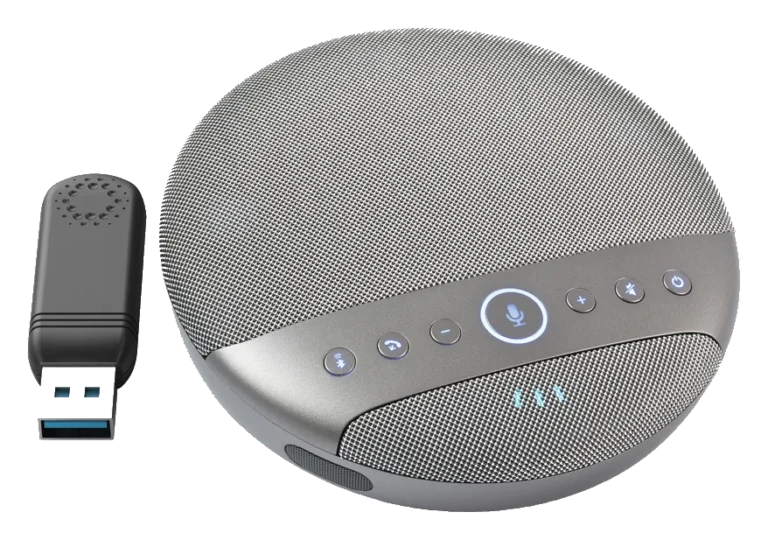
Products in this guide
FAQ
Is one microphone enough for a large meeting room?
Usually not. The pickup range of one microphone is a circle, and when the table is long and the seats are spread out, people outside the circle are not picked up and cannot hear the other side. Use several units to suit the length and shape of the table, with the circles overlapping.
How much does one SM-500 cover, and how many do I need?
One SM-500 picks up 360° within a radius of 4 metres. A table up to 6 metres takes one; a long table of about 12 metres takes three along the centre line; a U-shaped table of about 8 by 8 metres takes one on each of three sides; a bigger U-shaped table takes four. Up to four can be used together.
How many SM-800 units can be chained?
Up to six, connected one after another with the dedicated cable (5 metres each); the extension units are powered through the cable, so they need no separate power. One unit covers a radius of 3 metres.
How is the ceiling DMA-702 placed?
The DMA-702 goes on the ceiling and nothing is placed on the table. One unit covers a radius of 3 metres; a long table of about 6 by 10 metres takes two, a U-shaped table 8 to 10 metres wide and about 10 metres long takes four, and one about 14 metres long takes six, chained with network cable, up to six units.
Will several microphones interfere or cause echo?
No. When several are used together the sound plays in sync and the echo and reverberation are processed together. SM-500 units connect to each other wirelessly, SM-800 units are chained with the dedicated cable, and DMA-702 units with network cable.
What are the limits of omnidirectional microphones?
An omnidirectional microphone picks up all around, so you do not have to aim it at anyone, and for the same reason it cannot tell a voice from other sound: reflections off the walls, air conditioner and projector fan noise, and knocks on the table are all picked up. The further the talker, the weaker the voice, and the larger the share of these other sounds. Echo cancellation, noise suppression and automatic gain can reduce them, but the room itself still affects the result.
Our glass meeting room sounds muddy and echoey. What can we do?
First add sound absorption on the walls, by the windows and on the floor, for example carpet, thick curtains and acoustic panels. Then add microphones so every seat is closer to one, choose equipment with echo cancellation and noise suppression, and do not turn the loudspeaker volume up too high. If conditions are still poor, switch to close-up microphones, one per person, with an audio processor.
Should the microphones go on the table or on the ceiling?
If the table moves, or meetings are set up at short notice, tabletop units such as the SM-500 and SM-800 are more convenient. For fixed use where you want a clear table, the ceiling-mounted DMA-702 works. In a room with a very high ceiling or many reflections, a ceiling microphone is further from the talkers, so test with sample units in the room first.
How do I know how many are enough?
The numbers above are a guide based on table size; in practice table shape, seating, and wall and floor materials all matter. Test with sample units in the room first, and check that every seat is picked up clearly.
The planning advice in this guide is general reference. Actual results vary with the room, the equipment and the network. Product specifications follow the manufacturer's documents; we recommend contacting us for an assessment first.
More guides
How to choose a conference speakerphone: fixing sound that is unclear, echoing or noisy
You can hold a meeting without seeing the other side. You can't hold one if you can't hear them. Here is where meeting-room sound problems come from, and how to choose speakers and microphones.
Huddle Room Setup: One USB Cable, 2 to 6 People on a Call
A huddle room is used all the time and looked after by no one. This guide compares the three simplest setups: the SP-1100 all-in-one, the J01i with an SM-500 (UCB-S), and the A01 with an SM-500, and how to choose by headcount, room size and room to grow.
How to choose a meeting-room camera: 8 things to check, starting with room size
The camera is the most visible part of a video meeting. Whether remote people can see everyone, and see them clearly, depends on it. Work through these 8 points before you choose.